Extreme Universe
Laboratory
Skobeltsyn Institute of Nuclear Physics of Moscow State University Skobeltsyn Institute of Nuclear Physics of Moscow State University
русский / english
Get Adobe Flash player

Space-study of the re-ionization epoch of young Universe by using gamma-ray bursts and their afterglow

5 UNSOLVED OBSERVATIONAL GRB PROBLEMS

  1. The discovery of the most distant objects in the Universe.
  2. Prompt optical Short GRB emission detection.
  3. Optical emission Precursor detection.
  4. Polarization measurement of the prompt optical, X-ray and Gamma GRB emission.
  5. High time resolution observations of the prompt optical/IR emission.

1. The discovery of the most distant objects in the Universe.

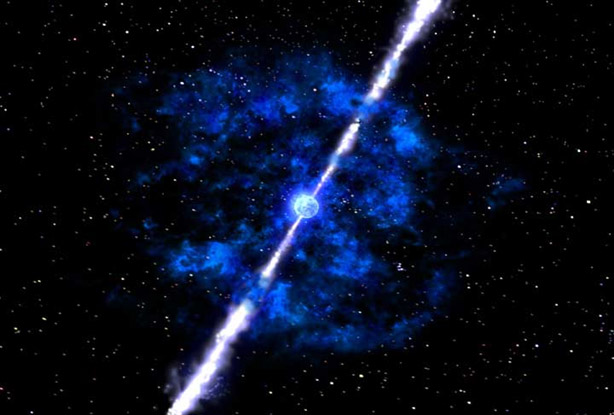
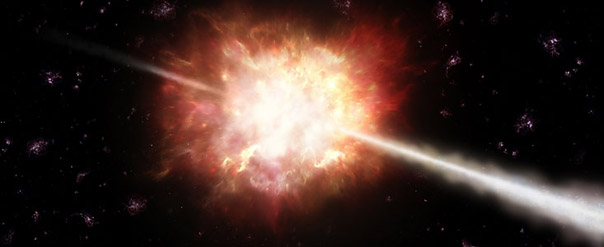
GRB is the brighter luminous source of the electromagnetic radiation in the Universe. So detection of the GRB can be provide discovery most yang gravitationally bounded object in the Universe. As the first we talking about Long GRBs, which physically connected with first massive star collapse in the Universe. The possible mass is about more then 30-100 solar mass with thermonuclear evolution time several million years. For example the typical age of the Universe is about:

T = 2/(3H) (1+z)(-3/2) ~ 7 106 (Z/100)(-3/2) yrs

The time is more than enough. But really the first stars formation connected with formation of the nonlinear gravitational perturbations. The more realistic (including CMB data) estimations give maximal red shift is about 12 or slightly more. For example, the discovery GRB at z>15 is means a new problems for standard cosmological model.

The Lyman continuum (912A) comes to infrared diapason to more 10000 A for z>10. The shorter ultraviolet quanta is absorbed. So Infra Red receiver is extremely needed!

2. Prompt optical Short GRB emission detection.

The short GRB is has typical duration less than 4 sec and more hard spectrum than long GRB. Due to such short time there are no optical prompt observations before now. Such type observations can be provided by very fast follow up equipment (like MEMS technology) and Very wide field monitoring (like SHOCK experiments, MASTER VWF cameras, TORTORA).

The SHOCK experiment on Lomonosov will be first Very Wide Filed (2000 square degrees) optical experiment in space.

3. Optical emission Precursor detection.

The precursor is the small (about several percents of all gamma ray fluence) flare some times occurs earlier (up to 200 s) than main burst. So the wait able precursor magnitude 5 mag more than main optical pulse (under the same mechanism assumption). There are 20 % of the all (short and long) GRB has precursors. The nature of the precursors is undefined (the first shock appearing on the surface of the progenitor star?, two stage collapse?...).

Such events can be observed by very wide field monitoring system like SHOCK and MASTER VWF cameras.

4. Polarization measurement of the prompt optical, X-ray and Gamma GRB emission.

There is no any successful optical, X-ray and gamma polarization detection of the prompt GRB emission. There is one 10% optical detection of the afterglow 3 minute after GRB trigger by Liverpool telescope1. There is one prompt (38 s after trigger time) optical polarizations in two polaroids GRB100906A by MASTER2 with negative result: polarizations less than 2%.

Popalimetric observations is very important for verification of the

  1. jet existence at all (directly)
  2. emission mechanism (Synchrotron, Inverse Compton and so...) and
  3. existing of the ordered magnetic field in jet.

5. High time resolution observations of the prompt optical/IR emission

The optical time resolution now is much smaller than in X-ray and Gamma-ray diapason. The most high resolution (1 sec) successful observations of the prompt optical emission was done by TORTORA observations of the naked-eye GRB080319B3.

The most high time resolution now presented by MASTER VWF, SHOCK, TORTORA is about 100-150 ms.

REFERENCES

1 Ten per cent polarized optical emission from GRB 090102 Steele, I.A., Mundell, C.G., Smith, R.J., Kobayashi, S., Guidorzi, C., 2009, Nature, 462, 767.

2 Gorbovskoy et al., MNRAS, 2011, (in press) GRB100906A, Astro-ph., arXiv:1111.3625v1.

3 Racusin J. L. et al. Broadband observations of the naked-eye γ-ray burst GRB 080319B, Nature. — 2008. — #455. — p. 183-188.

News

November 14, 2011
During the commemorating 300 year on the Birth Day of Mikhail V. Lomonosov Prof George F. Smoot was awarded the title of Honored Doctor of Moscow State University

Events

November 28-30, 2011
"Lomonosov" collaboration meeting.
November 28-30, 2011
Workshop on “Lomonosov” project that will be held in Moscow State University.

Scientific Partners


Lomonosov Moscow State University
Berkeley Center for Cosmological Physics
Paris Centre for Cosmological Physics
Institute for the Early Universe Ewha Womans University
2011 © Extreme Universe Laboratory
Skobeltsyn Institute of Nuclear Physics of Moscow State University
Lomonosov Moscow State University Skobeltsyn Institute of Nuclear Physics (MSU SINP),
1(2), Leninskie gory, GSP-1, Moscow 119991, Russian Federation
map